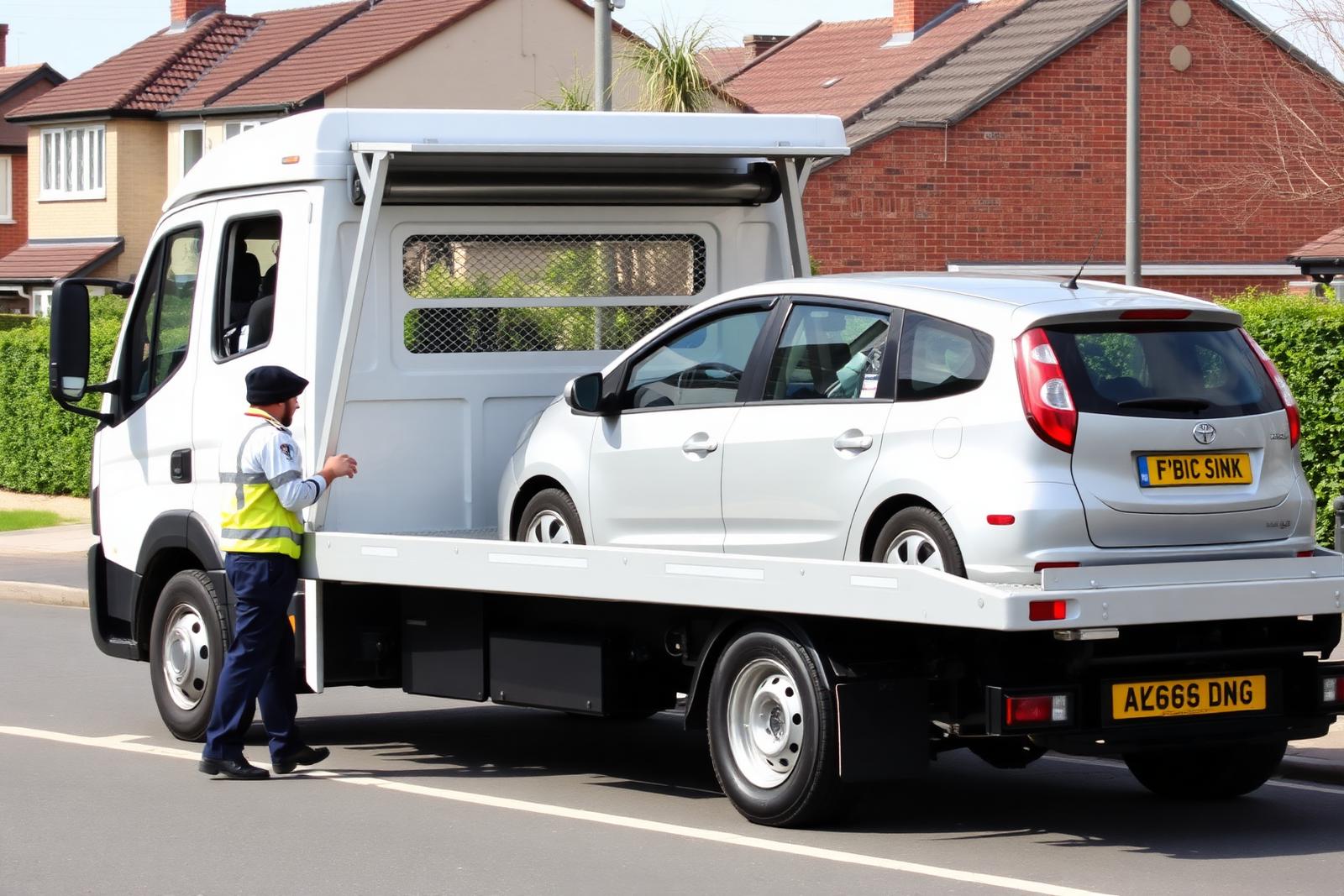
Start with the district and the vehicle entrance
East London covers several distinct pickup areas. Use the district in your first message, then narrow it to the road, property or car park entrance. Stratford, Leyton, Bow, Bethnal Green, Hackney, Canary Wharf, Ilford, Barking, Dagenham and Romford are useful starting points, but none identifies a loading position by itself.
If a building has a pedestrian reception on one street and vehicle access on another, send the vehicle entrance. For an underground collection, include the level, bay and signed clearance where already known. Contact site management about access before agreeing an arrival window. A pin at the building’s centre can send the operator to the wrong side of a large development.
Use the district guide for the actual parking setting
Stratford now has specific guidance for station, shopping and event parking. Canary Wharf explains managed-building access and basement extraction. Hackney focuses on street approaches, courtyards and business vehicles. Use the page matching the vehicle location; a famous landmark near your waiting point is not necessarily the pickup entrance.
For wider London destinations, the London hub connects central, north, west and south London guides. Greenwich covers a separate riverside pickup context. If the car is still on the orbital motorway, use M25 recovery with its actual direction and position rather than an East London postcode. These links support one agreed collection, not several overlapping bookings.
A Thames crossing changes the complete journey
For a collection north of the Thames with delivery to a south-bank workshop, give the receiving postcode at quotation stage. The practical route is part of the accepted transport job. A price discussed only for a local pickup does not establish the charge for the onward crossing and delivery.
TfL operates charges for the Blackwall and Silvertown tunnels. Check the official tunnel payment information for the current scheme, and ask whether applicable journey charges are included in the recovery quote. Do not assume that every recovery vehicle qualifies for a discount or that the car being collected has the same charging classification as the vehicle carrying it.
Check the correct London vehicle scheme
TfL’s ULEZ information explains the London-wide boundary and the distinction between lighter vehicles and heavier vehicles subject to different emissions rules. The M25 itself is outside ULEZ. That does not establish the status of a collection or delivery address reached after leaving it.
For a booking, the useful questions are which vehicle will attend, which route is proposed and how applicable charges are handled. Do not infer the recovery vehicle’s treatment from your own car’s registration result. Check the actual address and relevant vehicle using TfL’s official tools; a general East London postcode description is insufficient.
Managed estates, residents’ parking and basement access
For Canary Wharf or another managed development, identify the estate or building contact and the permitted recovery entrance. Say whether access uses security approval, a fob, a registration list or a staffed barrier. These are site-specific arrangements, not a standard permission covering every East London development.
A basement no-start may require both a starting assessment and an access assessment. State whether the car can select neutral or roll, if already known, and whether there is room to approach it. If it cannot be moved out normally, request car park and garage recovery. Agree any internal extraction and onward transport as separate parts of the scope.
Match the service to the East London pickup
A car that has stopped on a street may need breakdown recovery; a safely parked no-start may be suitable for a jump-start assessment. Collision damage belongs in an accident recovery enquiry, particularly when wheels, steering or scene release are affected.
The location can change the choice. A task that could be considered in an accessible parking space may be unsuitable beside moving traffic or behind a restriction that equipment cannot pass. Describe both the symptom and the setting. Do not book a battery service solely because the dashboard is dark or describe a collision-damaged car as an ordinary non-runner.
Give the receiving garage its own handover plan
An East London pickup may be delivered elsewhere in London, into Essex or farther away. The destination needs a full address, receiving contact, opening hours and acceptance of the vehicle in its present condition. Ask whether the workshop can receive a non-rolling car and where unloading is authorised.
If collection will happen late, confirm the key handover and access before dispatch. A garage’s postal address does not establish permission for unattended delivery. Where the receiver cannot accept the vehicle, agree an alternative or a specific holding arrangement and its cost. Do not leave the operator to choose a destination after loading.
East London and Essex are linked journeys, not interchangeable addresses
Ilford, Barking, Dagenham and Romford appear in this East London service group. Brentwood, Chelmsford and other Essex destinations should still be given by their actual town and postcode. Historic county wording on a business address can obscure the pickup if the exact entrance is missing.
For a journey towards Essex, use the Essex recovery page to review the different regional access context. For the first call, concentrate on where the vehicle physically is and where it must go. The accepted route and vehicle requirements determine the quotation; the label used by a directory does not.
Request an East London collection
Call or WhatsApp with the district, pin, vehicle model, mobility, access contact and destination. Add a safe photograph of the entrance if it clarifies the approach. Mention any tunnel crossing, building release requirement or receiving deadline you already know affects the journey.
Ask SYA Rescue to confirm the proposed work, suitability, price and current attendance estimate. Keep the acceptance message and report any change to the vehicle position or destination. These details make the enquiry actionable without implying that a truck is permanently stationed in every borough.