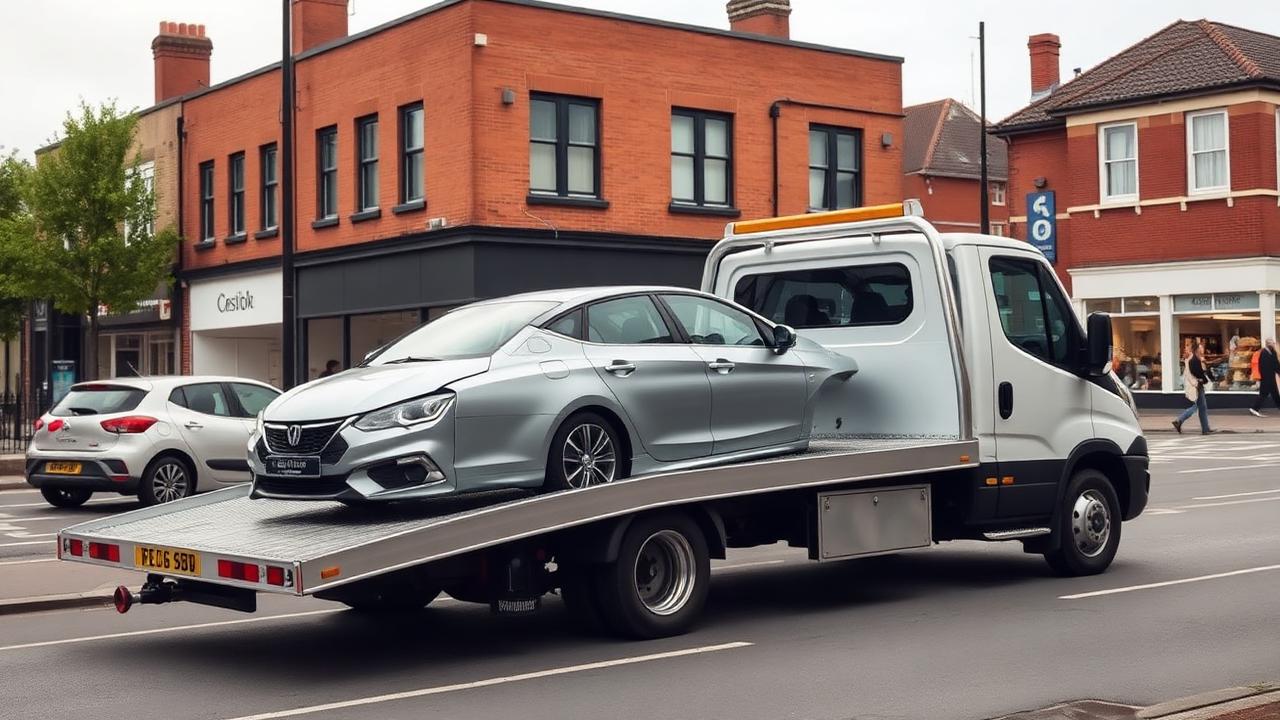
Roadside Assistance in Ilford: Help Before Towing
Roadside assistance in Ilford is intended for a roadside fault that may be assessed safely before vehicle recovery and transport is chosen. The practical goal is to identify a safe next step, resolve only what is appropriate on site, or escalate to recovery without wasting time.
The initial call or message should not be used to guess a fixed response time or promise equipment before the facts are known. Arrival and completion timing varies with traffic, access and service availability. Send a location pin and a factual description of what changed immediately before the vehicle stopped.
Pinpoint the collection in Ilford
This enquiry is for Ilford, East London. The existing area directory lists A12, A406, M11 as surrounding route references. These identify a wider approach, not an exact pickup or a promised travel time. Give the actual road, direction and nearest identifiable junction, or the full address and entrance for a property. Do not select a motorway name simply because it is near your town.
For a location between Ilford and Romford, Barking, Dagenham, Stratford, send the actual pickup pin rather than choosing the closest page title. Tell the team whether you are on the road itself, in a service area or on a separate site reached from it. Any site barrier, signed clearance or closing time belongs in the first message.
Confirm the destination independently of the collection area. The receiver needs to accept the vehicle in its current condition and within the proposed delivery window. Listing a nearby place does not establish a local depot, available equipment or automatic coverage; these are confirmed for the exact job.
Safety before arranging collection
If there is immediate danger or injury, contact emergency services and follow their instructions. Do not enter traffic to inspect the vehicle. Use the official breakdown guidance; for Northern Ireland use the nidirect guidance.
Can the Problem Be Assessed Safely at the Roadside? — Ilford
The service fits an Ilford request when the central need is to identify a safe next step, resolve only what is appropriate on site, or escalate to recovery without wasting time, rather than to obtain a different form of assistance. The service name matters less than the facts, so use the following decision guide.
Choose this service when:
• There is no collision damage or immediate fire, leak or medical danger.
• The fault may be minor enough for a safe on-site assessment.
• The person at the vehicle needs help deciding whether towing is necessary.
• The vehicle is in an accessible position with enough room to work.
• A battery, tyre, starting or minor electrical symptom can be described accurately.
Choose another route or obtain further advice when:
• A clearly unsafe mechanical failure may need immediate breakdown recovery.
• A collision-damaged vehicle requires accident recovery.
• Work should not be attempted where traffic, fire, leaking fluid or site rules make the position unsafe.
• A pre-planned vehicle movement belongs under transport rather than roadside assistance.
A practical test is to ask, “What must happen to the vehicle next?” If the answer is consistent with the outcome above, this service is likely to fit. If the answer is only “find out whether a small fault can be dealt with on site,” a related service may be better. If the answer is “deal with injury, fire or a live hazard,” vehicle recovery is secondary. In an Ilford request, this point becomes more specific when the caller reports passengers, access, keys and backup delivery and recipient details and any issue involving peak-hour congestion and time-sensitive route planning.
What Roadside Assistance May Include — Ilford
The scope of roadside assistance in Ilford should be understood as a sequence of assessed actions rather than a blanket promise to solve every vehicle problem. Depending on the confirmed circumstances, the service can involve:
• Triaging the symptom and checking whether roadside attendance is appropriate.
• Providing only confirmed assistance that can be carried out safely.
• Explaining when a temporary measure is not a reliable repair.
• Changing the plan to recovery to a destination when the vehicle should not continue.
• Coordinating a workable onward address if towing becomes necessary.
• Giving realistic schedule and cost information after the details are known.
These activities are connected. Accurate location and condition information influences the recovery method; the method influences available operating space and timing; the destination influences route, access and handover. A request is therefore incomplete if it gives only the town and registration while omitting the condition of the vehicle or where it should be delivered.
The service does not automatically include mechanical repair, legal advice, insurer approval, storage, passenger transport, specialist extraction or a particular item of equipment. Those matters have to be checked where relevant. The access and handover considerations—apartment blocks, gated developments and underground parking and peak-hour congestion and time-sensitive route planning—should be treated as questions to answer about the real job, not as assumptions.
For instance, a tyre problem where the safest repair option is uncertain calls for a different assessment from an accessible vehicle that starts, steers and rolls normally. Describe the vehicle honestly and allow the recovery arrangement to be matched to those facts.
Roadside Assistance vs Full Vehicle Recovery in Ilford
Different recovery services solve different problems. For a request in Ilford, use this comparison to decide whether roadside assistance is the closest match:
• Accident Recovery: use it when collision damage or an incident scene is involved.
• Long-Distance Transport: use it for planned collection or delivery rather than a roadside fault.
• 24/7 Vehicle Recovery: use it when urgent out-of-hours recovery is required.
• Breakdown Recovery: use it when the vehicle cannot complete the journey safely and towing is already the likely outcome.
The dividing line is often the intended outcome. This service is designed to identify a safe next step, resolve only what is appropriate on site, or escalate to recovery without wasting time. That differs from a service whose main purpose is roadside assessment, collision-scene handling, urgent out-of-hours dispatch or a pre-booked transfer. For the roadside assistance assessment in Ilford, record passengers, access, keys and backup handover address and contact and say whether the presence of peak-hour congestion and time-sensitive route planning creates a different approach.
Related guides include: Ilford; Roadside Assistance; 24/7 Vehicle Recovery Ilford.
Do not choose a service merely because its title sounds broader or more urgent. Explain the event, vehicle state, access and destination, and ask for the request to be placed under the most appropriate service. This reduces delay and helps the assigned team prepare for the live conditions.
When Roadside Work Is Safe—and When It Is Not — Ilford
Safety preparation for roadside assistance in Ilford should be proportionate to the actual risk. The person at the vehicle is not expected to diagnose the vehicle or place themselves in danger to inspect it. The useful approach is to protect people, make the position clear and report what can be observed from a safe place.
Important safety principles:
• Smoke, leaking fluid, excessive heat or brake and steering concerns require escalation.
• A temporary restart does not prove that a serious fault is repaired.
• High-voltage components must not be touched by unqualified persons.
• Roadside assistance is not appropriate where the working area is exposed to fast traffic.
Prior to arrival, prepare the following without stepping into traffic or entering a restricted area:
• Prepare a requested handover address in case on-site assistance is not safe or successful.
• Stop somewhere safer if the vehicle can still be moved without worsening the fault.
• Use hazard lights and keep occupants away from traffic.
Keep children, vulnerable passengers and animals under appropriate supervision. Remove only essential belongings that can be reached safely. Do not stand between the vehicle and moving traffic, beneath an unstable vehicle, near a spill, or in an area controlled by police or site staff.
How an assistance request is assessed
1. Deal with immediate danger and follow official instructions for the location.
2. Describe symptoms, model, drivetrain, keys and safe access.
3. Ask which assessment or task is suitable and available.
4. Confirm attendance, price, inclusions and the charge if the attempt does not resolve the fault.
5. Let the attending operator assess whether the agreed work can safely proceed.
6. If transport is needed, agree it separately with a receiving address and price.
7. Keep findings and follow-up advice for any later workshop visit.
Faults and Symptoms This Page Should Address — Ilford
Roadside assistance in Ilford may be requested for several different situations, but each one needs its own condition and access description. The following examples explain what changes the response:
**A minor electrical symptom.** Report exact location, direction of travel, level, gate or bay. The planning point is that not every fault can or should be repaired at the roadside. Avoid assuming the same method used for an accessible, freely rolling car will suit this situation.
**A warning light that needs a safe next-step decision.** Report registration, make, model and fuel or power type. The planning point is that parts, tools or specialist diagnosis may be needed at a workshop. Never presume the same method used for an accessible, freely rolling car will suit this situation.
**A vehicle in a car park, residential street or controlled site.** Report warning lights and a clear symptom timeline. The planning point is that unsafe or restricted locations can require immediate recovery rather than assessment. Do not treat it as automatic that the same method used for an accessible, freely rolling car will suit this situation. In an Ilford request, this point becomes more specific when the caller reports any attempts already made and their result and any issue involving apartment blocks, gated developments and underground parking.
**A temporary roadside measure that has not restored confidence.** Report whether the vehicle starts, moves, steers and brakes. The planning point is that the service cannot guarantee that a temporary improvement will last. Avoid assuming the same method used for an accessible, freely rolling car will suit this situation.
**A fault that needs escalation to a workshop.** Report any attempts already made and their result. The planning point is that arrival and completion timing varies with traffic, access and service availability. Do not treat it as automatic that the same method used for an accessible, freely rolling car will suit this situation.
**A no-start or intermittent starting problem.** Report passengers, access, keys and backup destination particulars. The planning point is that not every fault can or should be repaired at the roadside. Never presume the same method used for an accessible, freely rolling car will suit this situation.
**A battery or charging warning.** Report exact location, approach direction, level, gate or bay. The planning point is that parts, tools or specialist diagnosis may be needed at a workshop. Avoid assuming the same method used for an accessible, freely rolling car will suit this situation.
**A tyre or wheel concern where the vehicle should not be driven.** Report registration, make, model and fuel or power type. The planning point is that unsafe or restricted locations can require immediate recovery rather than assessment. Do not take it for granted that the same method used for an accessible, freely rolling car will suit this situation.
Vehicle Types, EV Limits and Technical Considerations — Ilford
Vehicle category matters for roadside assistance in Ilford because transmission, driveline, weight, clearance, wheel condition and power system can affect how the vehicle is assessed and moved. Supply the exact make and model rather than relying on a broad description such as “car” or “van.”
Vehicle categories that may require different planning include:
• Vans and light commercial vehicles within confirmed capability.
• Classic, modified and low-clearance vehicles.
• Vehicles in height-restricted or tightly controlled locations.
• Manual and automatic cars.
• Electric and hybrid vehicles, with high-voltage limits respected.
• Four-wheel-drive and all-wheel-drive vehicles. For the roadside assistance assessment in Ilford, record exact location, approach direction, level, gate or bay and say whether the presence of apartment blocks, gated developments and underground parking creates a different approach.
For automatic, four-wheel-drive and all-wheel-drive vehicles, explain whether the transmission can be placed in neutral and whether the wheels turn freely; do not force controls or tow in a manner that conflicts with manufacturer requirements. For electric or hybrid vehicles, disclose battery warnings, underbody impact, unusual heat, smoke or charging-related circumstances. A recovery operator should not ask an unqualified person to touch exposed high-voltage components. In an Ilford request, this point becomes more specific when the caller reports registration, make, model and fuel or power type and any issue involving peak-hour congestion and time-sensitive route planning.
Modified, classic, prestige and low-clearance vehicles need accurate dimensions and photographs where safe. Vans and commercial vehicles need load, weight and height information. A vehicle that cannot roll or steer may require a different loading approach, so describe the condition ahead of attendance rather than after access has been attempted.
Roadside-Assistance Coverage Around Ilford
Coverage for roadside assistance in Ilford needs confirmation against the exact collection point and live availability. Offering service in a location does not necessarily mean that SYA Rescue owns a depot, keeps a particular vehicle permanently stationed there, or can provide the same response time at every address. Each request is assessed using the vehicle position, access, condition and required destination.
A customer near the edge of Ilford, on a route between districts, at a rural approach, or inside a managed site should provide the full postcode and map pin. The assigned route may depend on which approach is open, whether the collection is time-sensitive, and where the vehicle must be delivered.
Nearby areas should be used as alternatives only when the relevant service is available and the route remains practical. A list of place names is less useful than a clear confirmation of whether the exact collection point and onward destination can be served, what timing is realistic, and what changes if the vehicle is outside the expected working area. In an Ilford request, this point becomes more specific when the caller reports whether the vehicle starts, moves, steers and brakes and any issue involving peak-hour congestion and time-sensitive route planning.
Related location or service guides include Ilford; Roadside Assistance; 24/7 Vehicle Recovery Ilford. Use the guide that matches the event and required outcome.
The final coverage confirmation belongs to the live assessment. Send a location pin and a precise account of what changed immediately before the vehicle stopped.
Call-Out, Diagnosis and Recovery Cost Factors — Ilford
The price of roadside assistance in Ilford cannot be calculated responsibly from the service name alone. A useful quotation explains which facts were used and what would trigger a revision. Common factors include:
• Size of the vehicle, access and site restrictions.
• Parts or consumables only when confirmed and authorised.
• Waiting, parking, tolls or third-party site charges where applicable.
• Time of day and traffic conditions.
• Onward destination and transport distance if towing becomes necessary.
• Distance and time required to reach the vehicle.
• The type of assistance requested and whether recovery is then needed.
To obtain an accurate figure, provide the exact collection point, vehicle information, condition, access and destination in one message whenever practical. Ask whether the quotation covers attendance, loading, mileage, waiting and handover, and whether storage, tolls, parking, additional labour or third-party site fees are separate. Do not rely on a starting price that does not describe the job.
A change in conditions can alter the quote. As an illustration, a tyre problem where the safest repair option is uncertain may require different planning from a freely rolling vehicle at an open roadside. A receiving site that is shut, missing key, inaccessible car park or inaccurate size of the vehicle can also create extra time or a second movement.
Price transparency works both ways. The person arranging the job should disclose the facts; the service provider should explain the basis of the amount and seek approval before carrying out materially different work, unless an immediate safety instruction from the authorities takes priority. Keep receipts or booking references where they are needed for a fleet, insurer or personal record.
Continuing the Journey or Choosing a Recovery Destination — Ilford
The destination should be agreed before a vehicle is moved from Ilford, wherever circumstances allow. Possible destinations for roadside assistance include:
• A dealership, fleet depot or workshop.
• A protected storage option or another receiving site if the first destination is unavailable.
• the driver's intended destination.
• A nearby garage or specialist repairer.
• The person at the vehicle's home or another authorised address.
A destination is suitable only when the address is correct, access is possible, the site is open or has an agreed out-of-hours handover process, and a person or documented method can accept the vehicle and keys. Give the handover contact the registration, expected reason for delivery and any reference they require.
If the preferred garage, bodyshop, dealer, depot or private address cannot receive the vehicle, agree a backup. That may mean another authorised address, secure vehicle storage where available, or a later transfer. Avoid assuming that a vehicle can be left outside a closed premises or that a neighbour, security guard or unattended key box is authorised to accept it.
At handover, record the destination, recipient, time, key arrangement and any visible condition information that is relevant and lawful to document. Where the presence of apartment blocks, gated developments and underground parking and the presence of peak-hour congestion and time-sensitive route planning affects collection or delivery, confirm the relevant details at both ends rather than only after transport has begun.
Symptoms and Vehicle Details to Share — Ilford
Prepare the following information when requesting roadside assistance in Ilford:
• Exact location, direction of travel, level, gate or bay.
• Registration, make, model and fuel or power type.
• Warning lights and a clear symptom timeline.
• Whether the vehicle starts, moves, steers and brakes.
• Any attempts already made and their result.
• Passengers, access, keys and backup receiving-site information.
Use observations rather than an unsupported diagnosis. “The engine turns but does not start,” “the front-left wheel is not straight,” or “the vehicle shows a battery warning” is more useful than naming a failed component without evidence. Update the assigned team if the vehicle moves, the road is closed, the destination changes, or a police, insurer, fleet or responsible person at the site gives new instructions. For the roadside assistance assessment in Ilford, record whether the vehicle starts, moves, steers and brakes and say whether the presence of peak-hour congestion and time-sensitive route planning creates a different approach.
A single clear message reduces repeated calls and helps the assessment of timing, price and equipment. Send a location pin and a clear account of what changed immediately before the vehicle stopped.
Parts, Specialist Tools and Service Limitations — Ilford
Some roadside assistance jobs in Ilford are limited by safety, access, kind of vehicle, authority or destination arrangements. The important limitations are:
• Arrival and completion timing turns on traffic, access and service availability.
• Not every fault can or should be repaired at the roadside.
• Parts, tools or specialist diagnosis may be needed at a workshop.
• Unsafe or restricted locations can require immediate recovery rather than assessment.
• The service cannot guarantee that a temporary improvement will last.
A difficult job is not necessarily impossible, but it needs to be described ahead of attendance. Send safe photographs where useful, measurements for restricted entrances, the vehicle's approximate weight or dimensions, and the name of the person controlling access. If the vehicle is in a ditch, behind a barrier, inside a low structure, carrying an unusual load or affected by a hazardous condition, state that clearly.
The plan may be revised to use a different access point, destination, time, method or specialist provider. That is better than pretending a standard response fits every situation. Where the risk is immediate, contact appropriate emergency responders or the responsible authority first. Where the issue is outside confirmed capability, seek the correctly equipped service rather than attempting unsafe movement.
Get the Right Help from SYA Rescue — Ilford
Trust in roadside assistance in Ilford should come from clear questions, realistic expectations and a documented handover—not from unsupported claims about being the fastest, cheapest or permanently local. A useful service conversation confirms the vehicle, condition, exact position, access, proposed handover point, price basis and any assumptions that still need checking.
SYA Rescue should explain when emergency responders take priority, when a related service is a better fit, what information is missing, what can vary the estimate, and what the caller should do while waiting. The person arranging the job also has a role: provide reliable details, remain reachable and disclose changes promptly.
Keep the case or job number, receipt or handover record when appropriate. Treat unverified promises about response time, equipment, local depots or completed jobs cautiously. The most credible service information is specific about the process and honest about limitations.
For a different vehicle situation, review the relevant service guide: Ilford; Roadside Assistance.
Send a location pin and an accurate explanation of what changed immediately before the vehicle stopped. Explain the exact issue and location so the request can be assessed as roadside assistance, not as a generic recovery enquiry.
Define the outcome you are requesting
Roadside assistance is an assessment and possible intervention at the vehicle’s location. Recovery is the movement of the vehicle to another place. A customer may need either or both, but the booking should distinguish them. Explain whether your priority is an assessment, a specific reported problem or direct transport to a workshop.
Ask which work can be considered for the vehicle and location you describe. A visit is not a guarantee that the vehicle can be repaired there or will be fit to continue its journey. Parts, access, equipment and the nature of the fault can all limit what is appropriate. Confirm the attendance scope and any next-step quotation before accepting the booking.
A safe working position matters as much as the symptom
An apparent minor fault does not make roadside work suitable in every position. Tell the dispatcher whether the vehicle is in a parking space, on a private driveway, at a service area or exposed to traffic. Describe barriers, ramps, limited working room and restrictions imposed by a site manager. The operator needs to assess access as well as the reported fault.
If the vehicle is on a motorway or other high-speed road, follow the road authority’s safety instructions rather than trying to prepare it for a repair. Do not move into traffic to open a bonnet, inspect a wheel or take a picture. Tell the dispatcher which observations you can safely provide.
Describe a starting problem clearly
Useful information includes whether the dashboard illuminates, whether the starter turns, whether a warning is displayed and whether the problem appeared after the vehicle was parked. Mention recent work or repeated failures without presenting a guess as a confirmed diagnosis. A starting problem can require a different response from a vehicle that starts but stalls or cannot select a gear.
Identify the exact vehicle and drivetrain. If you are seeking help with an electric or hybrid vehicle, explain the displayed message and whether the vehicle can be placed in its normal ready state. Do not assume that every no-start can be addressed by the same equipment or procedure.