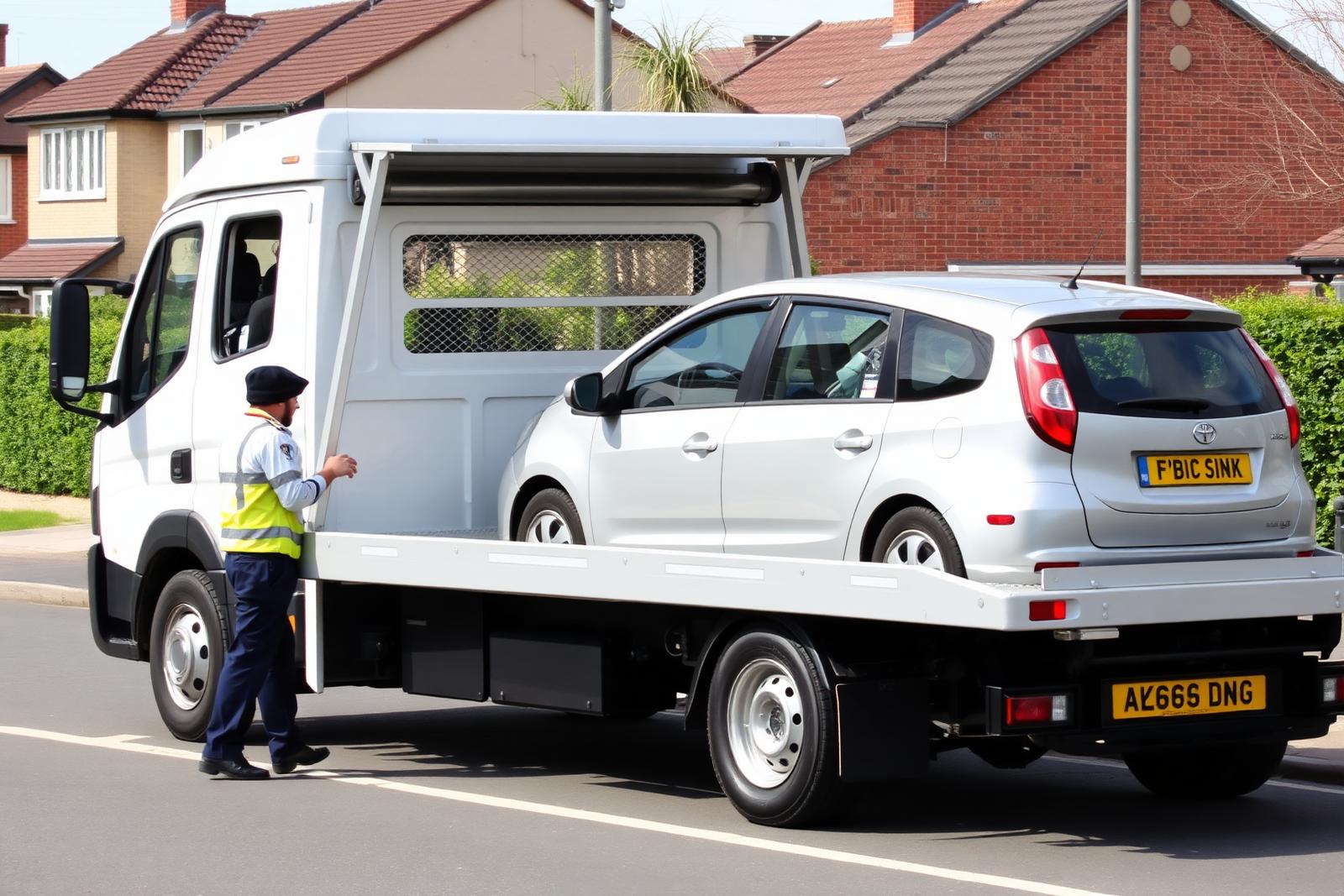
Leeds Roads, Parking and Collection Access
Describe the car’s position using the actual road direction or the entrance, level and bay of the premises. If a map pin marks a meeting point rather than the vehicle itself, tell dispatch so the correct access can be assessed.
Two local factors deserve particular attention:
• Residential streets, permit zones and constrained recovery access.
• City-centre loading, parking and pedestrian restrictions.
Mention either factor only when it affects the real job; avoid assuming that every collection in Leeds has the same conditions.
**High-speed and major-road positions.** A vehicle on a motorway, dual carriageway or fast road needs a safety-led response. Follow official signs and emergency instructions, do not walk in live lanes, and make the exact carriageway and direction clear. A broad reference such as “near Leeds” is not enough when two carriageways, slip roads or junction approaches lead to different access points. For the breakdown recovery assessment in Leeds, record keys, passengers, destination and site contact details and say whether city-centre loading, parking and pedestrian restrictions create a different approach.
**Car parks and restricted premises.** In a multi-storey, underground, gated or permit-controlled location, provide the clearance, ramp, turning space and exit arrangements. An operator who can reach an open roadside may not be able to enter a low or tightly controlled structure. Where safe, photographs of the entrance and vehicle position can help the assessment. For the breakdown recovery assessment in Leeds, record registration, make, model, fuel type and approximate size and say whether city-centre loading, parking and pedestrian restrictions create a different approach.
**Residential and city-centre access.** Narrow streets, parked vehicles, loading restrictions, pedestrian areas and controlled times can affect the collection plan. Do not reserve or block space unlawfully; instead, tell dispatch what space exists and whether a responsible site or property contact can assist.
**Commercial, institutional and managed sites.** Depots, business parks, hospitals, stations, universities, dealerships and workshops may have security, induction or opening-hour rules. Obtain the receiving or access contact before the vehicle moves. If the site will be closed, agree a lawful alternative rather than assuming keys can be left. For the breakdown recovery assessment in Leeds, record whether the vehicle starts, rolls, steers and brakes and say whether city-centre loading, parking and pedestrian restrictions create a different approach.
**Weather, visibility and temporary change.** Darkness, flooding, ice, event traffic, diversions or roadworks may alter an otherwise straightforward route. Report the conditions you can actually observe; do not rely on old directions or an earlier access promise. The recovery team can then reassess timing and approach.
The example of a clutch or transmission failure that prevents safe movement is a useful test. Ask what the recovery driver needs to know before entering the area, where the vehicle can be handled safely, and how the destination will receive it. Those answers make the request more accurate without assuming a depot, route, response time or completed job. For the breakdown recovery assessment in Leeds, record exact location and travel direction and say whether the presence of residential streets, permit zones and constrained recovery access creates a different approach.